
Get Help & Answers Now!


Everett HOV Lane and No Insurance Ticket Lawyer
Everett is a city of bottlenecks. I-5 compresses traffic between south Everett and the Snohomish River, US 2 delivers an entire stream of vehicles onto the trestle, and SR 526 funnels Boeing-area commuters toward the freeway. On the surface streets, Evergreen Way, Broadway, 41st Street, Pacific Avenue, and Marine View Drive add their own blend of buses, freight, local traffic, and abrupt lane changes.
A traffic stop in that environment can produce more than inconvenience. An HOV or no-insurance citation may affect your driving history, insurance costs, job, and monthly budget. Treating it like an ordinary bill may be the simplest response, but it is not always the smartest one.
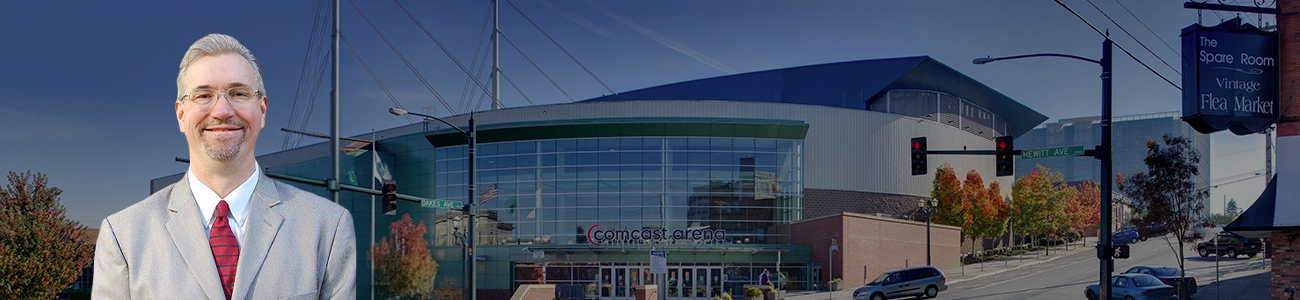
Attorney Jason S. Newcombe began his career as a prosecutor and tried his first criminal case in 1996. He entered defense practice in 1997 and has spent more than 25 years helping Washington residents with traffic infractions, DUI charges, criminal driving allegations, and other legal matters.
Jason completed four majors at the University of Oregon Honors College: finance, management, marketing, and history. He later attended Boston College Law School, graduating summa cum laude in the top five percent of his class.
That combination of prosecutorial and defense experience gives Jason practical insight into how a citation is prepared, how an officer’s report may be challenged, and which facts can influence a court’s decision. Together, Jason and his legal team have assisted thousands of clients throughout Western Washington.
Our Everett traffic lawyers offer free consultations to drivers who want to understand a ticket before selecting payment, mitigation, deferral, or a contested hearing.
The Citation May Not Tell the Whole Story
A traffic ticket records the officer’s conclusion. It does not necessarily contain every relevant fact.
An HOV citation may state that only one occupant was visible. It may not reveal the officer’s angle, how long the vehicle was observed, whether a child was seated below the window, or which sign applied at the entry point.
A no-insurance citation may show that you did not produce a valid card during the stop. It may not establish that the policy had actually lapsed. Your insurer’s application could have failed, the paper card might have been outdated, or the renewal document may have been sitting unread in an email account.
Those missing facts can change the case.
Begin by identifying the violation code, issuing agency, stop location, court, and deadline. Write down what happened while the details remain fresh. If another person was in the vehicle, record that person’s name and where they were seated. If insurance existed, contact the carrier immediately.
The quality of your response depends heavily on the information collected before the hearing.
Everett Has More Than One Possible Court
A ticket issued by an Everett police officer may be filed in Everett Municipal Court. The court is located at 3028 Wetmore Avenue and handles traffic infractions arising under municipal jurisdiction.
The official Everett Municipal Court page provides current hours and contact information. Everett also offers information about traffic tickets and hearings, including its hearing-by-mail option.
A Washington State Patrol citation issued on I-5, US 2, SR 526, or SR 529 may be filed in Snohomish County District Court instead. The Snohomish County District Court handles traffic infractions and criminal traffic cases within its jurisdiction.
Do not choose a court based on the Everett address closest to your home or workplace. Use the court printed on the ticket.
Both Everett and Snohomish County generally require a timely response. Snohomish County states that a driver must respond within 30 days of the violation date and that late hearing requests will not be accepted. Missing the deadline may result in a committed finding, added fees, and possible Department of Licensing consequences.
Everett’s Freeway Geography Complicates Lane Use
Few cities ask drivers to process as many freeway decisions in such a short distance.
Northbound I-5 approaches the 41st Street area, downtown exits, US 2, Marine View Drive, and the Snohomish River crossings. Drivers arriving from the west use SR 526, also known as the Boeing Freeway, to connect Evergreen Way, Seaway Boulevard, Airport Road, and I-5. Traffic from east of Everett enters through the US 2 trestle and merges near downtown.
When congestion builds, the HOV lane may be moving while general lanes slow to a crawl. A driver can be tempted to enter early, cross a restricted line, or remain in the lane after a passenger exits.
WSDOT has continued investing in Everett-area freeway improvements. Its SR 526 corridor project addresses traffic between Hardeson Road, Evergreen Way, and I-5. The agency is also studying US 2 trestle capacity and replacement, including the interchange and connecting city streets.
Roadwork does not excuse an HOV violation. It can change lane configurations, access points, visibility, and the context described in the officer’s report.
HOV Rules Follow the Signs, Not Your Assumptions
Washington law allows transportation agencies to reserve highway lanes for qualifying vehicles. RCW 46.61.165 classifies a violation of an authorized HOV restriction as a traffic infraction.
The signs posted along the particular corridor determine when the restriction applies and how many occupants are required. Rules used on I-405 express toll lanes should not be assumed to govern I-5 through Everett.
A Good To Go! account does not give a solo driver universal permission to use HOV lanes. Express toll lanes and traditional carpool lanes are different systems.
WSDOT’s HOV lane guide explains occupancy requirements and managed-lane rules throughout the region. Checking the current guidance is safer than relying on a rule remembered from an old commute.
The driver counts as one occupant. Every real passenger counts as well, including children and infants.
No Insurance Is a Bigger Problem Than No Card
A citation often causes drivers to focus on the document they failed to show. The policy itself is far more important.
Liability insurance can pay covered claims when you cause a collision. It may address another person’s repair costs, medical bills, lost wages, and other damages up to the policy limits. It may also provide a legal defense if a covered claim becomes a lawsuit.
Without insurance, those costs can become personal.
An accident on Evergreen Way may involve several turning vehicles. A freeway collision near the US 2 interchange can become a chain reaction. A crash on SR 526 may include commuters and commercial traffic traveling at freeway speeds.
The resulting expense can overwhelm the fine associated with a no-insurance citation. One modern bumper may contain sensors, cameras, wiring, and equipment requiring recalibration. Injuries that initially seem minor can lead to months of treatment.
Insurance is not merely proof you show an officer. It is a financial barrier between a bad drive and a lasting debt.
Washington Sets a Minimum, Not a Maximum
RCW 46.30.020 generally requires drivers to maintain automobile liability insurance or another approved form of financial responsibility.
The minimum limits are $25,000 for injury or death involving one person, $50,000 for injuries or deaths involving two or more people in one collision, and $10,000 for property damage resulting from that collision.
The Department of Licensing insurance guide explains the law and the limited alternatives involving approved bonds, certificates of deposit, or self-insurance.
Minimum limits satisfy the statute. They may not cover every loss.
A late-model vehicle can be worth several times the $10,000 property-damage limit. Medical expenses can exceed $25,000 before an injured person completes treatment. Drivers should discuss higher liability limits and optional coverage with a licensed insurance professional.
The Washington Office of the Insurance Commissioner provides public information about policies, claims, consumer rights, and insurance shopping.
Unusual Vehicle Situations Need Better Evidence
A no-insurance case can become complicated when the vehicle is borrowed, newly purchased, provided by an employer, or temporarily replacing a car in the repair shop.
Do not rely on the sweeping statement that insurance always follows the vehicle or always follows the driver. Policy definitions and exclusions determine whether coverage applies.
Contact the carrier and describe the facts carefully. Identify the vehicle, driver, owner, purpose of the trip, and date. Ask for the company’s conclusion in writing.
If another household member’s insurer may provide coverage, contact that company as well. The court needs proof connecting a valid policy to the actual trip, not merely evidence that someone near you owned insurance.
Check every effective date. A policy may begin at 12:01 a.m., at the time of purchase, or at another stated moment. A gap of several hours can decide whether dismissal is available.
False Proof Creates a Criminal Problem
Altering the expiration date on an insurance card is not a shortcut. Neither is presenting a canceled policy as active or submitting coverage for another vehicle without disclosing the difference.
RCW 46.30.040 makes knowingly providing false evidence of financial responsibility to an officer or court a misdemeanor.
An honest insurance lapse can be addressed through the civil traffic process. False proof may result in a criminal allegation and undermine your credibility.
If coverage existed, ask the insurer for accurate documents. If it did not, use mitigation, contesting, or another lawful procedure based on the facts.
An Uninsured Accident Can Affect Your License
Lacking insurance does not automatically make you responsible for a collision. Fault depends on what each driver did, along with roadway conditions, signals, witness accounts, video, and physical evidence.
The absence of coverage still creates serious disadvantages. You may have no insurer investigating the crash, dealing with the other company, negotiating a claim, or defending a lawsuit.
If you are found responsible, the other parties may pursue you for repairs, medical treatment, wage loss, and other damages. A judgment can lead to lawful collection efforts against available income and assets.
Washington’s Financial Responsibility Law may also permit license suspension when qualifying accident damages remain unpaid. The DOL explains that process on its failure-to-pay-accident-damages page.
When a collision accompanies the citation, preserve photographs, traffic-camera information, witness names, repair estimates, medical records, and communications from insurers.
The City of Everett maintains a public traffic-camera page showing monitored intersections such as Broadway and Pacific Avenue. Availability and retention of any particular recording should be investigated promptly. Situations like these demand attention from a respectable Snohomish County traffic lawyer.
Choosing Among Payment, Mitigation, and Contesting
Payment is administratively easy but ordinarily accepts the infraction.
Mitigation is designed for a driver who does not dispute the violation but wants the court to consider the circumstances. A judge may reduce the monetary penalty where authorized, but the violation may still be reported.
A contested hearing is appropriate when you deny committing the infraction or have a legal defense. The government must prove the allegation by a preponderance of the evidence.
Everett Municipal Court offers traffic-infraction hearings by mail. Snohomish County has its own hearing procedures. Written proceedings can save travel time, but the judge must decide from the submitted documents. You cannot answer a new question after the review begins.
Consider whether the dispute depends on testimony, visibility, roadway configuration, or another fact better addressed in a live hearing.
The Final Risk Check
Before responding, ask four questions.
Did valid insurance cover the vehicle at the exact time of the stop? Can the insurer prove it clearly? Was another passenger present during the alleged HOV violation? What will a committed finding do to your record, job, or premiums?
Those answers are more useful than a general feeling that the ticket was unfair.
An Everett traffic ticket attorney can review the officer’s report, lane signs, observation conditions, insurance documents, and court rules. No responsible lawyer can guarantee dismissal. A careful review can still prevent you from admitting an infraction that the available evidence does not support.
Everett Traffic Ticket FAQs
Which court will handle my ticket?
Everett Municipal Court may handle citations issued under city jurisdiction. State Patrol or county citations may be filed in Snohomish County District Court. Use the court identified on the ticket.
How long do I have to respond?
Snohomish County requires a response within 30 days of the violation date. Confirm the deadline printed on your citation and follow the named court’s instructions.
Can an insurance citation be dismissed?
Yes. If you prove that qualifying coverage existed when you were cited, RCW 46.30.020 requires dismissal, although administrative costs of up to $25 may be assessed.
Does insurance purchased after the stop count?
It protects future driving but does not prove coverage existed earlier. The effective date and time control.
Does an infant count in an HOV lane?
Yes. Children and infants count as occupants even when an officer cannot easily see them.
Is an HOV ticket a moving violation?
Yes. A committed HOV infraction may appear on your driving record and may influence insurance or employment.
Can I pay to enter every HOV lane?
No. Traditional HOV lanes and express toll lanes follow different rules. A Good To Go! account does not authorize solo use of every restricted lane.
Do I automatically need an SR-22?
No. The requirement depends on your license status and the event involved. Confirm your obligations with the Department of Licensing.
Can I contest the ticket by mail?
Everett Municipal Court offers hearings by mail, while Snohomish County has its own procedures. Review the correct court’s current instructions before choosing.
Why speak with an attorney about a civil infraction?
A lawyer can assess the evidence, identify dismissal requirements, protect deadlines, and explain how each court response may affect your record.
Turn the Ticket Into a Manageable Decision
An Everett traffic stop may have lasted only a few minutes. The result can affect your finances for much longer.
Obtain the officer’s report. Request insurance documents. Preserve passenger information, photographs, toll records, and details about the roadway. Most importantly, respond before the deadline.
Our Washington State traffic ticket lawyers happily assist drivers facing no-insurance citations, HOV violations, speeding tickets, negligent-driving allegations, and other Washington traffic matters. Contact our Everett office today to arrange a free consultation.